Showing posts with label Stevens. Show all posts

Thursday, November 12, 2020

2020 - Gratitude Day #12 - My Grandparents

 Gratitude Day #12 

Today I am grateful for my grandparents.

It's difficult to imagine that my grandparents were born in the late 1800s. And I knew each of them personally.

My Dad's parents were Richard Lee and Fannie Collier Clemens. Dad was #5 out of eleven children, so I can only imagine how difficult it would have been to raise a family of that size in the hollers of eastern Kentucky. They would raise all but two of those children to adulthood. 

Older brother Cecil had died at three months old from whooping cough. 

Little Betty died while sitting in her big sister's lap in a rocking chair. As she rocked, she would push off on the pot belly stove in front of her, not realizing that with each "push", a pot of beans inched toward the edge.

And, it fell on little Betty. 

This sweet 3 1/2 year old girl suffered for three days before her eventual death. Their feelings on the death of any of their children would be no different than mine today.

I don't think my Dad's family had much money, for it doesn't appear that they lived in one place for very long. I am working on two big projects right now that include ICAPGen renewal, as well as for the First Families of Ohio lineage society. Tracing my dad's family began with him and continuing on back. All I can say at this point is that their life was extremely hard and poor.

But, they made it. It's funny how my sisters and I returned to Olive Hill, Kentucky to look for the house we can all remember making visits to. It was a huge white house with a red roof and a wrap-around porch.

Suddenly it just doesn't seem so huge anymore. My sisters kept asking:

"Where's the apple orchard?"

"Where's the hill grandpa rode a hog on?"

I don't know. I can't help you.

The house on College Hill.

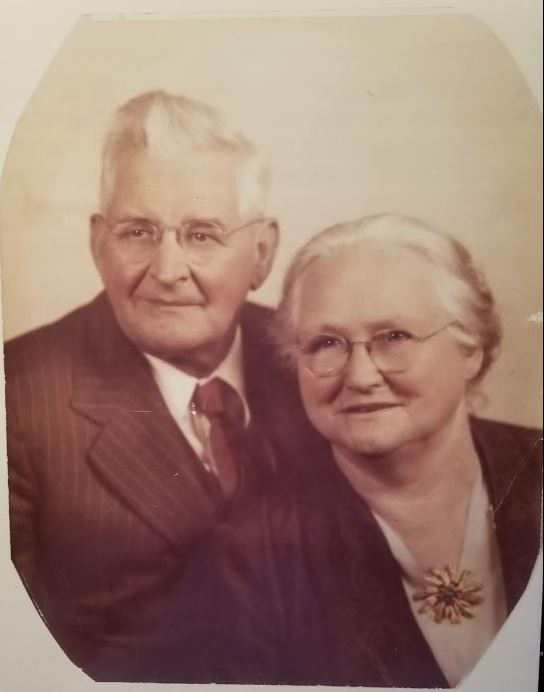
Richard Lee and Fannie Collier Clemens

Richard Lee and Fannie Collier Clemens

My mom came from a good family lineage. I have more memories of her parents than I do of my dad's, for when his parents died I was only about age 5 & 6.

I often wonder how any of my grandparents made it through the 1918 flu epidemic. Mom was the oldest of a large family of boys, and two of those boys were lost during that time. Her aunt Harriett lost three children. It wasn't unusual for people to lose many children or other relatives.

Mom's parents were Corbitt Sullivan Stevens and Bertha Agnes Gearheart. For years I wondered how papa Corb got his name, for we have found no one in the family named either Corbitt or Sullivan. No one. 

So, a few years ago, I asked my uncle if he knew where the names came from. He said, "Sure! It was from two prizefighters!"


I am grateful for the good and happy times I had visiting their homes, eating their food, and listening to their stories. They are the ones who connect me with history - my history, their history, American history.

The house built by Corb Stevens, Lawton, KY

Corbitt Sullivan Stevens

Bertha Agnes Gearheart Stevens


Friday, November 15, 2019

2019 - Gratitude Month #15 - My Grandmother's Whoopin'

All four of my grandparents were born in the late 1800's. That is just mind-boggling to others when they hear that. And, it's mind-boggling to me, too! People are surprised when they learn that I actually knew people from the 1800's. Just look at all they saw!
Let me relate a snippet. Each year, my parents and I drove to eastern Kentucky where my grandmother lived. My parents had grown up there, too, as well as my three sisters. The hill are steep and the hollers are deep.
My mom was afraid for my her mother to live alone during the winter months. She still heated her home with a pot-bellied stove that was fueled by coal, which meant going out back to fetch the coal. Mom was afraid she would slip and fall and no one would discover her. She had no phone.
We went to get her in October and drove her back in March - plantin' time.
She slept in my bedroom, which was downstairs. She got up every morning at 4:30 am, fixed her own breakfast of eggs, sausage, biscuits, and coffee so strong that a spoon would stand up in it.
My dad fixed a special chair for her by the fireplace he had built. She warmed her arthritic knees by the fire, and spit tobacco juice into a green bean can. One day, I had taken a bath and washed my hair, which hung to my waist. I put on my warm flannel nightgown and went to dry my hair by the fire. As I stood there talking to Mawmaw, I shook my hair to speed its drying. All of a sudden, my arthritic grandmother flew up out of her chair, grabbed the hearth broom that was used to sweep ashes, and knocked me to the floor, whooping the daylights out of me!
The only thing I could think of was, "What on earth did I say this time?"
Mawmaw saved my life. My nightgown was smoldering, and was ready to ignite. She knew the signs, and didn't take the time to explain. She just went into action. People from that era worked daily around fires, and had seen their share of burns. And, it probably gave her some satisfaction to be whoopin' that smart-aleck 13-year old grandchild of hers!

Saturday, January 11, 2014

She saved me so much time and money!

I had to really give this one some thought.

Gilbert Stephens was an ancestor of mine who fought in the Revolutionary War.  He served from Virginia, later moving his family to Morgan County, Kentucky.

Years ago, I sent for his pension file from the National Archives.  It was a large one, costing a total of $72!  The day it arrived was indeed a happy one.  And, nothing else got done in my house for several days as I read through it.

Gilbert was entitled to bounty land for his service in the Revolutionary War.  We were a country that was cash poor, but land rich.  The last years of his life was spent trying to secure the necessary proof needed for his land.

Then, he died.  Wife Nancy Osborn Stephens was left to continue on with the quest.  And, this quest went on for years.

She spent those years trying to produce the needed proof of her marriage to Gilbert.  Many, many documents are included in the pension file that attest to witnesses having known them all of their married life, and that they were indeed married.

It wasn't good enough.

Even their sons wrote that their parents were indeed married.

That wasn't good enough.

Nancy asked a man to go back to Virginia to see if anyone was alive that could remember the wedding, which took place at Thomas Leadingham's home, where she was a servant.

The man went, but died when he was there.  

One of the final pages in the pension file indicates the following:


Nancy states that after years of trying to prove she was indeed married to Gilbert Stephens, "she expects she will not be able to produce any public record of her marriage".

This absolutely touched my heart.  She was 88 years old and couldn't remember if she was married in 1796 or 1797.  Dozens of friends and relatives stated their knowledge of Gilbert and Nancy being husband and wife, including her own brother, Jesse.

But, none of it was good enough.

In the end, she actually was given the bounty land due to her and Gilbert.  


She died a very short time later.

Saturday, March 9, 2013

Women's History Month - #9


March 9 — Take a family document (baptismal certificate, passenger list, naturalization petition, etc.) and write a brief narrative using the information.

I had to really give this one some thought.

Gilbert Stephens was an ancestor of mine who fought in the Revolutionary War.  He served from Virginia, later moving his family to Morgan County, Kentucky.

Years ago, I sent for his pension file from the National Archives.  It was a large one, costing a total of $72!  The day it arrived was indeed a happy one.  And, nothing else got done in my house for several days as I read through it.

Gilbert was entitled to bounty land for his service in the Revolutionary War.  We were a country that was cash poor, but land rich.  The last years of his life was spent trying to secure the necessary proof needed for his land.

Then, he died.  Wife Nancy Osborn Stephens was left to continue on with the quest.  And, this quest went on for years.

She spent those years trying to produce the needed proof of her marriage to Gilbert.  Many, many documents are included in the pension file that attest to witnesses having known them all of their married life, and that they were indeed married.

It wasn't good enough.

Even their sons wrote that their parents were indeed married.

That wasn't good enough.

Nancy asked a man to go back to Virginia to see if anyone was alive that could remember the wedding, which took place at Thomas Leadingham's home, where she was a servant.

The man went, but died when he was there.  

One of the final pages in the pension file indicates the following:


Nancy states that after years of trying to prove she was indeed married to Gilbert Stephens, "she expects she will not be able to produce any public record of her marriage".

This absolutely touched my heart.  She was 88 years old and couldn't remember if she was married in 1796 or 1797.  Dozens of friends and relatives stated their knowledge of Gilbert and Nancy being husband and wife, including her own brother, Jesse.

But, none of it was good enough.

In the end, she actually was given the bounty land due to her and Gilbert.  

She died a very short time later.


Tuesday, March 5, 2013

Women's History Month - #5

Onward we go with the lives of valiant women!


March 5 — How did they meet? You’ve documented marriages, now, go back a bit. Do you know the story of how your parents met? Your grandparents?

My mom used to tell me that she and dad met at church.  Then, she would later say that they didn't really grow up going to church.  So, I'm not sure how they met, other than the fact that Dad worked at the limestone quarry where Mom's father, Corb Stevens, was the foreman.
The old limestone quarry at Lawton, KY.  It was later a mushroom factory, where the conditions were perfect for growing mushrooms.


My dad's parents, Richard Lee and Fannie Collier Clemens.  The story about how they met is unknown to me.  
My mom's parents, Corb and Bertha Gearheart Stevens.  The story about how they met is unknown to me.

How sad it is that these people that I knew so well in my life have stories that will never be known to me.  I can only surmise that their love story echoes that of my parents; they married because there wasn't anything else to do.

In eastern Kentucky, opportunities for going beyond the few counties around one's home were few.  You married who you knew; those your parents knew, those you went to school with, those you saw at church, those that lived up the holler.

Oh, if I could just have about five minutes more with each of them!

Tuesday, January 1, 2013

How Pawpaw Got His Name

My maternal grandfather's name was Corbett Sullivan Stevens.


Pawpaw was born in 1892 in Winkler, Elliott County, Kentucky.  We think.

Corbett Sullivan is not really a Kentucky name.  It has no hillbilly roots.  And, there is absolutely no namesake, no naming pattern, nothing that would elude as to why he was given this name.

His own father died at a very young age.  He was only 27 years old, and his mother eventually married again.
The Stevens name is quite common in eastern Kentucky.  Many of them are descended from Gilbert Stevens/Stephens, a Revolutionary War patriot who eventually moved to Morgan County, Kentucky.  It has not been difficult to follow his descendants.

My mother often said that Pawpaw didn't really know his own birthdate.  When asked to provide one for military service or Social Security, he basically made one up.  The date he made up was 6 Sep 1892.  Apparently, it was good enough.

Recently, I was talking with my uncle, the last of the long line of children from Corb and wife Bertha's family.  I asked him if he had any idea how his father had gotten his name.  Uncle Dick replied that he thought he was named after a prize fighter.

A prize fighter?

I came home and began to do a Google search on anything about the name Corbett Sullivan.  A whole new world opened up to me.

James J. Corbett was quite the prizefighter.  He was a professional boxer and World Heavyweight Champion.  His father brought the family from Ireland.
http://en.wikipedia.org/wiki/James_J._Corbett

His most famous fight was against John L. Sullivan, which took place on 7 Sep 1892.  Now, scroll upwards and look at the birthdate of my grandfather again.

John Sullivan was the first American athlete to earn over a million dollars.  He was born in the South End of Boston to Irish immigrant parents, and was known as The Boston Strongboy.  In 1892, he agreed to defend his title by fighting Gentleman Jim Corbett in New Orleans.  Tickets went for the hefty price of $5-15, and the venue was filled with 10,000 spectators.


Corbett was younger and faster, and was able to dodge the blows from Sullivan.  After 21 rounds, it was over.  Corbett had won the fight against Sullivan.  Later, Sullivan remarked, "If I had to get licked, I'm glad I was licked by an American."
http://en.wikipedia.org/wiki/John_L._Sullivan

Apparently, news of this fight made it all the way to the hills and hollers of Eastern Kentucky.  And quite possibly, my mother's family knew of it.

Now, do I know for sure that my grandfather was named in honor of this famous fight?  No.  I don't know that I'll ever know that for sure.  What I do know is that for several earlier generations, there is absolutely no one named Corbett or Sullivan in the Stevens family of Eastern Kentucky.

I am grateful for www.wikipedia.com for providing the information necessary for this blogpost.  I would never have known about it otherwise.


Monday, July 9, 2012

A Kentucky Funeral

It was just two short weeks ago that we learned of the death of my cousin, Gregory Earl Stevens.

Greg was the only child of my aunt and uncle, and the apple of their eye.  They were married 14 years before he was born.  It would be hard to find a son better loved than Greg.
Have you ever seen a prouder look in a father's eye?

Greg was only 42 years, and his life ended in an ATV accident.  He was not horsing around.  He came up out of a creek bed and got stuck in some weeds.  When he gunned it, it flipped backward on him, crushing him badly.

It has been many years since I attended a Kentucky funeral.  As a young girl, my memories were not always pleasant ones.  I remember wakes that lasted through the night while the body lay in state in the parlor or front bedroom.  Someone would bring up politics or religion, and mom knew it was time to send me upstairs to bed.  "Discussions" would begin in the dining room, move to the living room, the front porch, and eventually right out into the front yard.

Women would begin bringing in the food, trying to find room for it all on the groaning table.  There would be periods of crying, coupled with periods of laughter and memories.

All of this was called "sittin' with the corpse".

The funeral service was held at the local church, accompanied by a very loud preacher.  I mean no disrespect by stating this.  But, to a little girl it can be quite overwhelming - even frightening.  The church my family attended in Ohio was quite a bit different.

My sisters and I left early in the morning to drive to Olive Hill, Kentucky.  We've driven Rt. 23 south many times in our life - mostly for funerals or Decoration Day.  We were still in shock, but talking with each other greatly eased some of our grief.  We all have good memories of Greg, and of our Aunt Betty and Uncle Dick.

The funeral chapel was in Globe, and the parking lot was already packed.  When we pulled in, we were greeted by someone who is actually a shirttail relative of ours.  I asked him when the next Cline Reunion was going to be, since we hadn't been to one in 12 years.  He said there hadn't been one since then.

People were looking us over.  First of all, most of the cars and trucks were Chevys and Fords.  We drove up in my sister's Toyota Sienna.  We all had skirts on.  There weren't many others who wore skirts or dresses.  I'm sure they were wondering who in the world we were.

We spotted my uncle first.  I was amazed at how much he had aged in the short time since we've seen him.  He embraced me and told me to take lots of pictures.  I mentioned that some people might not like that practice, but he said he didn't care.  He wanted pictures.  Period.

Among all of the beautiful flowers was a bevy of quilts that people chose to send.  I've seen this in the past, but neither of my sisters had.  What a tender way to cuddle up in comfort long after the flowers are gone.
As the choir came in, each member paused to embrace the family.  I was so touched.  Their hugs and love were genuine.  They began to sing, and I was immediately taken back to my childhood.  In my heart and in my mind, I could remember every word.  The peace and comfort began to flow over me.

A wonderful bagpiper played "Amazing Grace" as we filtered into the cemetery.
After a few words at the cemetery, we all traveled up Rt. 174, past Aunt Betty and Uncle Dick's house, past Greg's house, all the way up to Porter Creek Fellowship Hall.  When I walked in, I was taken aback by the tremendous amount of food that had been brought in.
I have never seen so much food at a funeral.  Actually, I've never seen that much food at any of our church socials.  The table seemed to go on for miles, sometimes three deep across the table.  The dessert was located against the wall.

Some of was catered, most was homemade.  My mind again returned to my childhood as I grazed my way through fried chicken, mashed potatoes, fried corn, green beans picked that morning, cornbread, red tomatoes, yellow tomatoes, cucumbers, stack cake, butterscotch pie, chocolate pudding, etc.  I can't even begin to list it all.  The sweet church ladies kept coming around asking if we got enough, and reminding us about the "to-go" boxes that were available.

I sat and talked with my aunt for a long time, my sisters sat with my uncle, who just couldn't eat.  Greg's only child, Ericka, sat across from us with her little daughter, Skylan.  Ericka couldn't eat, either.

Our hearts were broken as we left them for our trip back home.  But, knowing the people in the eastern hills of Kentucky, my aunt and uncle and Ericka will be well taken care of in their grief, their sorrow, their long days to come.  The church and neighborhood family will step in to be the comfort they need in our absence.

There are no more cousins on this side of the family.  My uncle is my mother's only living brother out of a family of eight children.  Mom was the oldest.  Uncle Dick is next to the youngest.  

This funeral brought sweet memories back to me - memories of being a little girl without a whole lot of understanding to a woman grateful for the experiences of childhood.  

Tuesday, October 18, 2011

How Important Are Family Legends?

I grew up listening to all sorts of legends about our family's history.  My parents were from eastern Kentucky, and they passed on stories they had heard from their parents, which had been from heard from their parents, which had...

You get the idea.

In the genealogical world there is much discussion about correct citations of our sources.  There probably isn't a genealogist alive that hasn't wished they could go back and do things a little bit better.  I remember thinking, "Oh, I'll always remember where that was."  Then, life got in the way and I don't have a clue.

But, back to the family legends - perhaps we ought to listen a little bit closer to those stories.  Try as I might, I could not locate a single fact in our family's history that pointed to our having Dutch lineage.  But, Dad insisted that was what this ancestor was always called.

Dutch.  Dutch.  Dutch.  Deutch?

Yep, that was it!!!  The line was German!!!  That made a lot more sense, because a lot of the German foods and traditions were passed on through the family.  I just didn't realize it.  The sausage, the sauerkraut, the Christmas legends, etc.

But, one legend still continues to haunt me.  One of my mother's grandfathers was Robert H. Stevens/Stephens.  He fought in the Civil War.  He settled back into Elliott County, Kentucky.  He died.

A few years after his death, the legend was that a Doctor Brown (?) was supposed to assemble a skeleton as part of an exam.

The legend was that Robert's grave was disturbed.
,
The legend was that someone ran upon Doc Brown in the woods with a big pot of boiling water.

The legend was that a hand floated to the top.

The legend was that Doc Brown kept a skeleton hanging in his closet for years.

Now, this all makes for some wonderful storytelling.  But, that's not what I'm after.  I'm just trying to find where he was buried.

A few years ago, my uncle told me that a picture existed of Robert, and that it was hanging in the home of a cousin who was in her 80's.  I really wanted to see it, and perhaps take a picture of it.  He told me to go up to the house and knock.  If there wasn't an answer, just look through the door, for it was hanging right inside within viewing distance.

Now, we are talking Kentucky.  You just don't do something like that.  But, I figured there wasn't any other way to see that picture.  My husband and four young children drove up to the house, and I told them to stay put.

I knocked on the door.  There was no answer.   Looking at the hound dog out of the corner of my eye, I took my chances and looked through the door.  It was hard to focus, but that's because just an inch away on the other side of the glass was another pair of eyes looking at me!

I thought for sure I was dead.

This was my mother's dear cousin and childhood playmate.  She reminded me so much of my mother - same hair, same arms, same laugh.  I wanted to get right to the point, but there are some very important points to remember when visiting someone in the south:
1.  Do not, under any circumstance, rush.  If you're foreign, or from the north (in my case, Ohio), you've got to earn their trust.
2.  Ask how the garden was this year.
3.  Ask how the family is doing.  Include the hound dog.
4.  Talk slowly.  Don't try to imitate the "twang".  You'll just sound silly.
5.  Again, don't rush.  Things go at a different speed.  Adapt to it, no matter how anxious you are to get the information and get on the road.

We had a wonderful visit as she shared such fond memories of my mother.  We did finally get around to talking about family, and I asked her about the picture that was indeed hanging on the wall.  She took it down for me to look at, and I gave it a good "goin' over".

I was amazed at the family resemblances that were in this man's facial features that have carried right on down through the generations.

I asked her where she had gotten it.  She slapped her leg and said that some people up the holler had been tearing up their linoleum and ran across it.  (People often placed layers of newspapers and other papers between the floorboards and the linoleum to help insulate against the cold.)  She said Robert's name was even on the back of it, though I didn't ask her to take it out of the frame to look at that.  I kind of wish I had.

She agreed to let me take a picture of the picture, so I took it outside and placed it under a tree so the sun wouldn't glare on it.  This was before the days of digital cameras, so I took several pictures with my inexpensive Vivitar 35mm to make sure at least one turned out.
Robert H. Stevens/Stephens, md to Rachel M. Burton

I have since downloaded his Civil War Pension File, and learned that he served in the Union Army, and at one point was taken as a prisoner of war.  In the 1890 Kentucky Veteran's Census, he is living at Hogtown, Elliott Co., KY, where he states he had a pain in his side and he broke his foot during the war, possibly due to:  "A sudent jar from shells by cannon".

He's a bit of a hero to me.  He's in the Civil War, he dies, perhaps is dug up and hangs in a doctor's office for years.  His picture stays under the linoleum for years and is finally uncovered.  My husband asked, "Were they singing 'I'm Walkin' the Floor Over You'?"

Smarty pants!  Quit talking about my grandpa!!

Wednesday, September 21, 2011

Mom's First-Hand Memories of the Flu Pandemic of 1918

Mom was nearly five years old when she and brother Thearl noticed a smoky haze that smelled like burnt leaves that came rolling through their area of Kentucky.

Soon, people were sick and dying. 

Her father, Corb Stevens, was busy making caskets for everyone that died.  He was soon overrun with requests.  Mom said that eventually she and her mother, Bertha Gearheart Stevens were taken sick.  She didn't know if she would live or not.  After several days in bed, she was able to lean up from her bed and look out the window.  In the valley below the house, the caskets were lined up in rows.  There was no one well enough to bury the dead.

There was hardly a family that was not affected by this terrible flu.  Mom was the oldest in her family, and she lost two little brothers.  Her mom's sister, Aunt Harriett, lost three children during 1918. 

It's getting more and more difficult to find those that lived through and survived this flu pandemic of 1918.  I'm fortunate that my mom lived, and so did her mother. 

But, I think of the mothers that buried children and the children that buried mothers.  I've seen the graveyards where the tombstones tell the stories of grief, of losing several family members within just a couple of months.

Their feelings would be no different than ours today...
Little Zearl Stevens, brother of my mom, Ida.  He would have been 3 years old during the pandemic.  He is buried in the Brown Cemetery, Lawton, Carter, Kentucky.